The Best Temperature for Sleep, and How to Get There
Most sleep specialists point to a cool bedroom, roughly 60 to 67°F. Here is why temperature matters, why your number may differ, and how to fine tune it.

Ask ten people for their ideal bedroom temperature and you will get ten answers. There is still a well known starting point: most sleep specialists suggest a cool room, roughly 60 to 67°F (16 to 19°C), for adults.
Key takeaways. Start around 60 to 67°F (16 to 19°C). Adjust in small steps. Remember that you sleep in a small climate under your covers, and that is the temperature that matters most.
Why temperature matters for sleep
Your body temperature follows a daily rhythm. It drifts down in the evening as you head toward sleep and reaches its lowest point in the early morning hours. A cool sleeping environment works with that pattern, while a warm one works against it. That is why a hot, stuffy room makes it harder to settle, and why many people wake during the night when they overheat under heavy bedding.
None of this means colder is always better. Being too cold is just as disruptive, and comfort is personal.
A useful starting range: 60 to 67°F (16 to 19°C)
If you have never thought about it, set your bedroom somewhere in the low to mid 60s and see how you feel after a week. Babies, older adults and people with medical conditions can have different needs, so follow your doctor's advice if that applies to you.
Why your number may be different
- Bedding. A heavy duvet and flannel sheets need a cooler room than a light cotton sheet.
- Sleepwear. What you wear changes how much heat you keep.
- Mattress and topper. Dense foam can hold heat close to the body.
- Season and humidity. Humid air feels warmer at the same temperature. Aim for moderate humidity, roughly 30 to 50 percent.
- Your partner. Two people rarely agree. See our guide to sleeping at different temperatures.
- You. Body size, age, activity and habits all play a part.
The room is not the bed
The number on your thermostat measures the air in the room. What you actually feel is the temperature at the surface of the mattress and under your covers, which can sit several degrees above the room. That gap is why some people set the room cold and still wake up hot.
How to find your number in two weeks
- Keep your bedding the same for the whole test.
- Set the room to about 65°F (18°C) for four nights and note how you feel on waking.
- Move it down or up by 2°F (about 1°C) and repeat for four more nights.
- Keep notes on how quickly you fall asleep, how often you wake, and how you feel in the morning.
- Settle on the setting that feels best, then adjust with the seasons.
Going beyond the thermostat
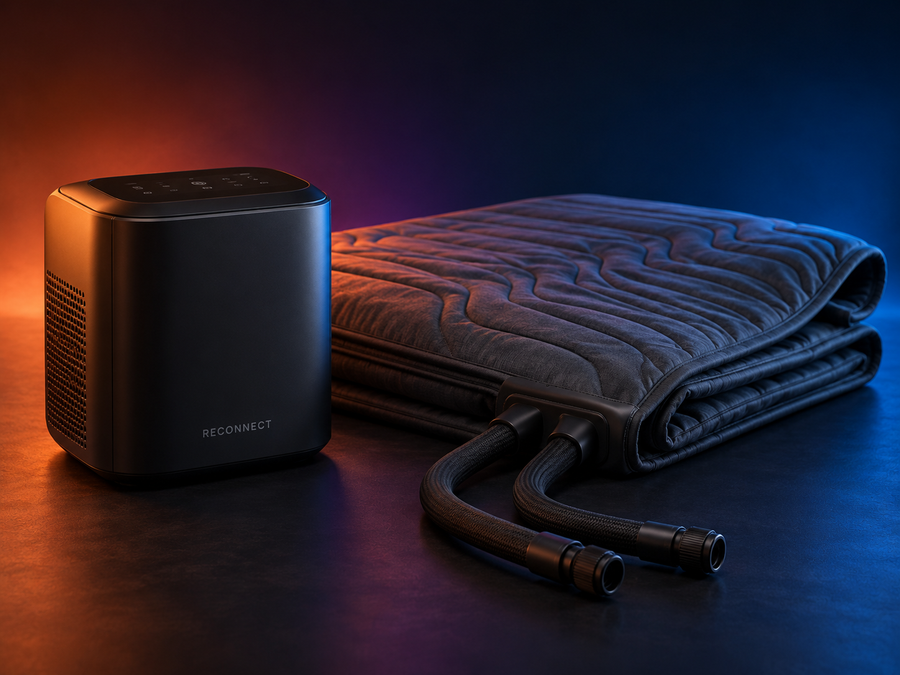
Cooling a whole bedroom all night costs energy, and it will not suit everyone in the bed. A bed cooling system works on the sleep surface instead. RECONNECT circulates water through a low-profile Mattress Pad under your fitted sheet. Cooling water settings run from 54 to 95°F (12 to 35°C) and heating settings from 77 to 131°F (25 to 55°C). Those are circulating-water settings, not mattress-surface temperatures, so the result depends on your room and bedding. It takes around 30 to 45 minutes to reach your setting, which is why most people start it 30 to 60 minutes before bed.
Curious how it fits into an evening routine? See how it works or read the setup guide.